“Internet For All” $50b Contract to End Manufactured Crises Through Circumvention & Accountability | Project Focus EPA $2b with Complimentary RFP Selection & Analysis
⏬ [SF, GOLDEN DOME & DRONES] | GRANT WRITING MASTERS CLASS | OVERALL AVG IS 98.2 AAAAAAAAAAAAAAAAAAAAAAAAAAAAAAAAA
Gravity Motors OH daddi-0 DIS is done dude!!!
MULTI-MILLION-DOLLAR GRANT (Merit-Based Accountability) APPLICATION (only for a grade, but could be replicated to a certain extent based on content and research, but…..)
⬇️ 📁 FILES ⬇️ 📁
⬇️ 📁 2026_March 21_Pentagon Workforce Readiness for Electromagnetic Energy Shift STEM Education_W4Assgn1_Kerr_J (Stratton = Maiden Name til 10/9/2008) �https://drive.google.com/file/d/1JRfw3L8loYRvyKvWevNTtLBuDD2h1Hoo/view?usp=drive_link
GRANT APPLICATION PIECES | NTIA-BEAD-2022 | SC PROJECT SPERO RESURRECTED for $3.6 TRILLION RENEWABLE ENERGY CHANGEOVER
⬇️ 📁 2026_March 29_Needs Goals OBJ ACT_100 A_W5_6881_Gravity Motorz 3-6 trillion_BEAD GRANT 2022_Prof suggests submission
https://drive.google.com/file/d/1xAIFutwwnijPQvj9VMwq9VBBdI5bzx0o/view?usp=drivesdk
⬇️📁 2026_April 5_6881 grants_M4Assgn1_Kerr_J_97 A_FP PT 2_Methodology and Evaluation Plans_Satellite Labs to prevent infectious disease outbreaks via daily H20 and Soil Sampling
https://drive.google.com/file/d/1Ao65jFY_iXJU_6ZreUdY1v6xLTsnoteH/view?usp=drivesdk
⬇️📁 2026_APRIL 12_100 A_CHARLIE KIRK_M4W7Assgn2_NTIA-BEAD_EACH LAB costs with sustainability past grant funding_FINAL Budget with Itemizations.pdf
https://drive.google.com/file/d/1x00aTSEy0nUV4yc9dbSuT26L2__aAYf8/view?usp=drivesdk
⬇️📁 2026_APRIL 26_94 A_M5Assgn_6881 Grant Writing_Cover Letter and Abstract_NTIA-BEAD-2022_Gravity Motors and Satellite Labs daily water sampling.pdf
https://drive.google.com/file/d/1oBs3yhaj-STPpToD1cvU72tukaikde8u/view?usp=drivesdk
References
(Backlash from State Agencies due to decreasing profit, but if they reduce overhead, then that equates to LESS WASTE & MORE PROFIT) Jangjoo, S., & Tang, T. (2025). Renewable energy transitions from the ground up: Building a framework for local action despite limited state support. Cities, 158, Article 105737. https://doi.org/10.1016/j.cities.2025.105737
Popa, D. C., & Szabó, L. (2024). Securing Rare Earth Permanent Magnet Needs for Sustainable Energy Initiatives. Materials (Basel, Switzerland), 17(22), 5442. https://doi.org/10.3390/ma17225442
Magnets & Geothermal Energy Direct Correlation through Electromagnetic Induction:
Trifonova, P., Metodiev, M., Hristova, D. , & Kolcheva, K. (2025). Geothermal Sources Detected by Magnetic Anomalies and their Relation with Hot Springs and Geology: A Case Study from Bulgaria. Earth Systems & Environment. https://doi.org/10.1007/s41748-025-00814-9
Hawley, J. [@SenatorJoshHawley]. (2026, February 11). Chairman Hawley exposes fraud in state and federal programs and dark money funding web [Video]. YouTube. https://youtu.be/DlzQ9sPyx5E?si=aEu17Hm6o-zxvvE4
NTIA-BEAD-2022 (e.g., https://broadbandusa.ntia.gov/sites/default/files/2022-05/BEAD%20NOFO.pdf) & Spartanburg (SC) Counties “Project Spero” needs the Stratton® Gravity Motorz™ (e.g., https://www.strattonworldwide.com/shop/p/gravitymotorz) to offset the expense of all data centers! NOT catastrophic Nuclear Waste getting dumped in oceans killing the planet at lightning speed!
Figure 1
“Three Types of Character” (Paul & Elder, 2020, p. 13)

2026_March 3_Paul and Elder Three Types of Character.jpg
NOTE: According to Paul and Elder (2020) (e.g., Figure 1), a fair-minded person embraces change in service to others (and self) ethically, honestly, and compassionately. In terms of grant applications, Gitlin et al. (2021, p. 26) recommends competing for larger grants, “casting a wide net,” engage in pilot studies when pursuing grant funding for any research initiative in alignment with government initiatives. Hence, the goal of this response is an attempt at accomplishing both recommendations by the aforementioned authors/researchers.
The main Request for Proposal (RFP) for this terms project is in response to the Environmental Protection Agency’s (EPA’s) Environmental and Climate Justice Community Change Grants Program (Grant ID No. EPA-R-OEJECR-OCS-23-04 found at https://www.grants.gov/search-results-detail/351071), where $2 billion is offered in cooperative agreements for community-driven projects that address climate challenges and pollution reduction plus emphasize equity and environmental justice (Environmental Protection Agency [EPA], 2023). This grant that focuses on transformational investments in underserved communities aligns closely with Spartanburg County’s “Project Spero” initiative that could create new models for geospatial technologies (GT), artificial intelligence (AI), and information systems (IS) for resilient crisis response and sustainable social impact (Harrelson, 2026, para. 1). Thus, an effort at answering some of Harrelson’s (2026) questions. To accommodate interdisciplinary aspects of the project, two (2) complementary RFPs and Notice of Intent (NOI) are identified:
U. S. Department of Energy (DOE) FY26 Technology Commercialization Fund (TCF) – Commercialization Enabling Topic Lab Call (https://eere-exchange.energy.gov/#FoaIdc7d4aa1b-b32a-466e-b4e7-6404d0f7f8e7) (U.S. Department of Energy [DOE], 2026) helps to address barriers in commercial deployment of energy-related innovations so that technology validation and market readiness can be addressed. This funding complements that of the EPA project by allowing for the development and expansion of AI, GT, and IS that form the basis of those tools as solutions for a crisis-mitigation model applicable in practice, beyond investigation and research.
DOE Critical Minerals and Materials Accelerator [NOI - i.e., Letter of Intent] needed by vendors to participate and/or be included in budget/consideration for RFP application funding and future correspondence [Symms, 2023]) (https://eere-exchange.energy.gov/#FoaId61687146-d965-4694-b84d-3e7df833dc9c) (DOE, 2025). The DOE (2025, 2026) is focused on collaborative partnerships and pilot testing for accelerating the recovery of critical materials processing. Given that mineral displacement and energy equipment for infrastructure projects (e.g., the Spartanburg Data Center) are tied to environmental and engineering components of the project. Thus, this NOI addresses the project by establishing more sustainable management of resources linked to climate resilience and resource relocation for additional infrastructure projects (e.g., repurposing).
National Institutes of Health (NIH) Collaborative Program Grant for Multidisciplinary Teams (PAR-27-003) (https://grants.gov/search-results-detail/361322) (National Institutes of Health [NIH], 2026) provides for studies that focus on integrated research, where specialists from various disciplines tackle complicated health and social discrepancies. This fits well with health equity and systemic abuse components inherent in the project that invite interdisciplinary collaboration to advance community health.
Together, these RFPs and NOI offer a synergistic funding base that considers environmental justice, technology, resource sustainability, and health systems involved. Furthermore, this summary supports the goals of the EPA project concept and U.S. Golden Dome initiative by 2030 (U. S. Department of Commerce [DOC], 2024).
Proposed SMART Goals | Circumvention of Manufactured Crises
Specific: Integrate a streamlined AI-driven, human-monitored, and managed crisis response system (CRS) for deploying drones powered by gravity motors (https://strattonworldwide.com) by December 2027. Objective is to deploy a comprehensive crisis response program (CRP) (with dedicated network towers and wildlife cameras) where AI, GT, and IS solutions integrate into the application of real-time tracking technology (PILOT: enhancing early damage assessment in Spartanburg County, South Carolina with Clemson University Wildlife & Fisheries program and Walden University [online]) across the United States (U.S.) for the Golden Dome by 2030 (and Internet for All with estimated contract budget of approximately $50 billion total) (DOC, 2024).
Measurable: Decrease emergency response times by 20% and improve accuracy of damage predictions by 30% within three years of project initiation. PRIMARY GOAL: Saving consumers by eliminating fraud, waste, and abuse (at the core) with accountability held for all court systems against insurance company (fraudulent) damage assessments and processing of insurance claims for victims (e.g., manufactured crises [Hawley, 2026]).
Attainable: Collaborate with at least three local community organizations (e.g., Habitat for Humanity [https://habitat.org, J2 Rescue & Rehab, Inc. [https://j2rrinc.org] & Space Foundation [SF] [https://www.spacefoundation.org/what-we-do/education/], two academic institutions (e.g., Walden University & Clemson University), and one federal laboratory to co-author and substantiate scientific standards [https://nasa.gov]).
Relevant: Redress environmental justice (e.g., Clemson University Wildlife & Fisheries Program https://www.clemson.edu/cafls/academics/graduate/wildlife-and-fisheries-biology.html) and health inequities with prioritization of underserved populations (https://bcm.edu & https://www.houstonmethodist.org/academic-institute/research/) through system deployment zones.
Time-Sensitive: Finish the program pilot test and roll out to the community by Q4 2027.
Example Budget (3-Year Project) Summary
Personnel (Project Director, Data Scientists, Community Liaisons): $5,000,000.
Technology Development (R & D: Software, AI models, GIS hardware): $5,250,000.
Partner Collaborations & Subcontracts (Academic & Lab partners): $4,000,000.
Community Engagement, Training & Scholarship: $3,000,000.
Administrative & Overhead (15% indirect expenses): $2,587,500
Overall Cost Estimate: $19,837,500
NOTE: EPA (2023) mentions up to two, $20,000,000.00 contracts with addenda can be awarded to a single entity if justified.
This is the budget, which meets grant limits (EPA Community Change Grants 1M–20M) (EPA, 2023), and reflects the interdisciplinary, partnership-based, technology-oriented strategy essential for the project to achieve success.
References
Environmental Protection Agency (EPA). (2023). Environmental and climate justice community change grants program (EPA-R-OEJECR-OCS-23-04) [Unpublished grant proposal]. Grants.gov. https://www.grants.gov/search-results-detail/351071
Gitlin, L. N., Kolanowski, A., & Lyons, K. J. (2021). Successful grant writing: Strategies for health and human service professionals (5th ed.). Springer Publishing Company. https://doi.org/10.1891/9780826148049
Harrelson, S. (SH). (2026, February 26). Project Spero and pauses… Real questions are just beginning. SH. https://samharrelson.com/2026/02/26/project-spero-and-pauses-real-questions-are-just-beginning/
Hawley, J. [@SenatorJoshHawley]. (2026, February 11). Chairman Hawley exposes fraud in state and federal programs and dark money funding web [Video]. YouTube. https://youtu.be/DlzQ9sPyx5E?si=aEu17Hm6o-zxvvE4
National Institutes of Health (NIH). (2026). Collaborative program grant for multidisciplinary teams (PAR-27-003) [Unpublished forecast opportunity]. Grants.gov. https://www.grants.gov/search-results-detail/361322
Paul, R., & Elder, L. (2020). The miniature guide to critical thinking concepts and tools (8th ed.). The Foundation for Critical Thinking. https://bookshelf.vitalsource.com/reader/books/9798765194232?library_return_url=https%3A%2F%2Fbookshelf.vitalsource.com%2Fhome%2Fmy-library
Symms, R. D. (2023, July 4). How to write a letter of intent to bid: Tips, examples & template. Responsive. https://www.responsive.io/blog/letter-of-intent-to-bid
U.S. Department of Commerce (DOC). (2024, September 27). Biden-Harris Administration delivering on promise to connect everyone in America to reliable high speed internet service. DOC. https://www.commerce.gov/news/blog/2024/09/biden-harris-administration-delivering-promise-connect-everyone-america-reliable#:~:text=The%20Biden%2DHarris%20Administration's%20Internet,on%20time%20and%20on%20track
U.S. Department of Energy (DOE). (2025). Critical minerals and materials accelerator [Unpublished notice of intent]. U.S. Department of Energy (DOE). https://eere-exchange.energy.gov/#FoaId61687146-d965-4694-b84d-3e7df833dc9c
U.S. Department of Energy (DOE). (2026). FY26 Technology commercialization fund: Commercialization enabling topic lab call [Unpublished grant proposal]. U.S. Department of Energy (DOE). https://eere-exchange.energy.gov/#FoaIdc7d4aa1b-b32a-466e-b4e7-6404d0f7f8e7
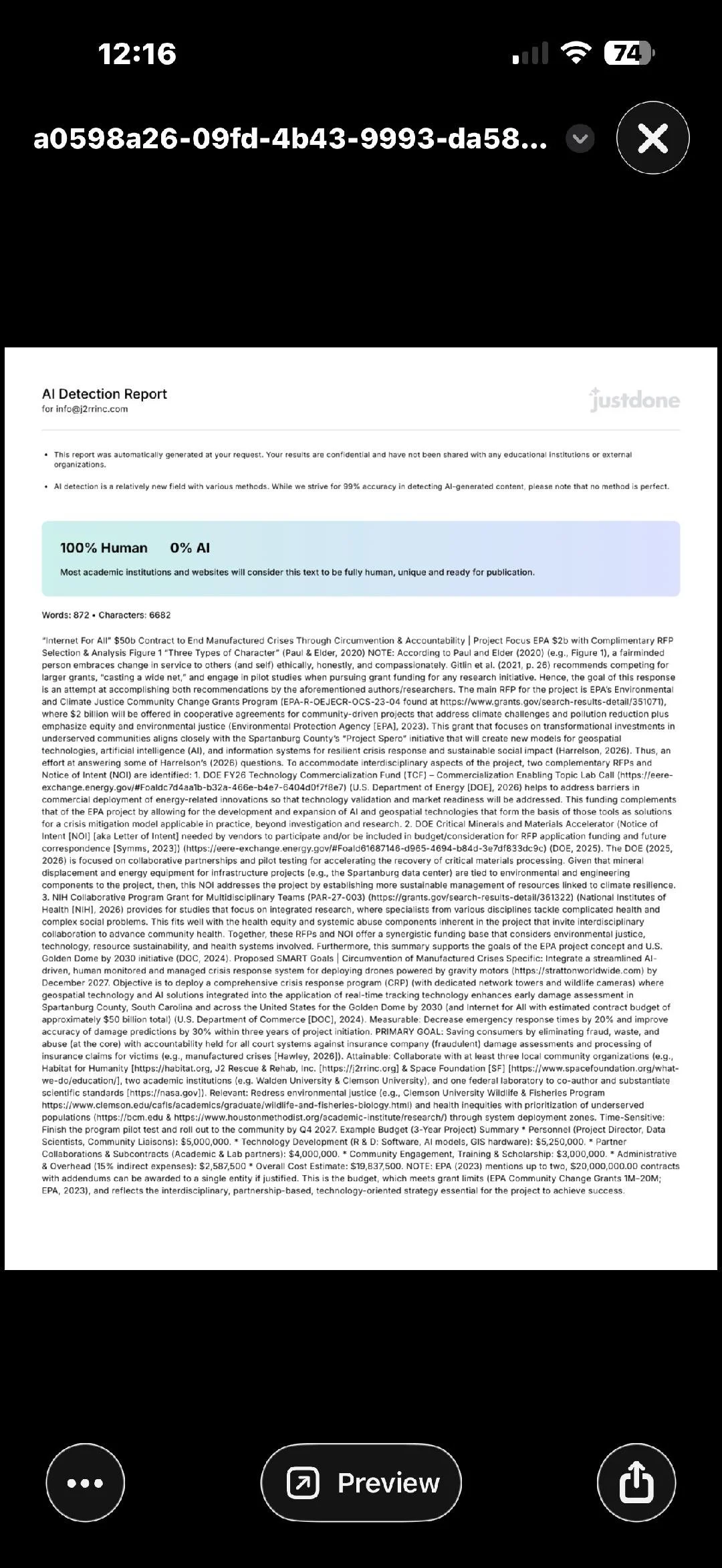
2026_March 3_100 human JustDone_Paul and Elder Three Types of Character.jpg